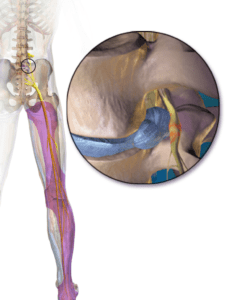
The sciatic nerve begins as a group of nerves that travel from the lower back through the hips and buttocks down each leg to the calf and into the foot. Irritation of this nerve can originate at different points along the course of the nerve from the spine to the foot.
I have found that people visiting the Laura Turner osteopathy clinic in Exeter describe sciatic pain as anything from a mild ache to severe pain, burning or sharp, some people notice weakness in the muscles that are supplied by the sciatic nerve. The key indication of it being sciatica is the location of the pain along the nerve.
When you visit your osteopath they will assess your case history and ascertain what may be causing the pain.
Common causes of sciatica
Sciatica occurs when the nerve is pinched or irritated. This can be caused when a disc bulges in your spine or bony growth that makes the space where the nerve exits the spine at the vertebrae smaller, further along the path of the nerve it can be irritated by tight muscles such as the piriformis muscle, in some people the sciatic nerve runs through the piriformis muscle. On rare occasions, the pressure can come from a tumour putting pressure on the nerve or a disease such as diabetes that can damage the nerve.
What should I be aware of?
Mild pain will usually go away on its own and will not require treatment, however, it can be reassuring to check in with your healthcare provider to assess the cause.
The most important thing to know is if you have any changes to your bladder or bowel control or numbness around your saddle area (often noticed when wiping after going to the toilet) it is time to make a visit to A+E.
How can an osteopath help?
Your osteopath will assess the potential cause of your sciatic pain and then treat the appropriate areas as required with stretching, massage and movement. Some people that I have seen with sciatica at the Laura Turner Osteopathy clinic in Exeter have reported immediate relief from treatment, for some a few treatments were required before experiencing relief. All people that have an appointment with Laura receive personalised tips and exercises to use throughout their day so they can help themselves at home to either experience relief or reduce the risk of reoccurrence.